| Status: | Active, open to new members |
| Leader: | |
| When: | On Friday afternoons Occasional day trips |
| Venue: | Various |
| Cost: | £4 for indoor meetings |
Leader: Richard Woodroofe
The group meets on various Fridays, sometimes in URC hall, sometimes at other venues. The charge for indoor meetings is £4, including tea/coffee.
Please contact the Group leader for further information. If no response after 7-10 days contact the Groups Co-Ordinator.
NB All Group Leaders: Very Important
1. Please inform the Website Administrator of any changes ASAP so that your groups information shows correctly.
2. Regarding any photographs published on the website, you must have the photographer's permission and also the permission of any recognisable individuals visible in the picture. See our website terms and conditions (in the footer of every page on the site).
Forthcoming events
PAST EVENTS
In August 2023, members of the group joined forces with U3A members from Bradford-on -Avon, Warminster, and Shaftesbury U3As in a joint visit to an archaeological dig at Teffont. Excavations there commenced a few years ago and are expected to continue for a few years more. The site is of a Roman temple and its associated buildings. This year the dig is unearthing what appears to be accommodation blocks areas for domestic staff and visitors to the temple which was located several hundred yards away. From the finds both this year and previously the buildings were constructed in the early years of the Roman conquest, probably before 100AD. A grave with human remains was discovered near a building likely to have been for accommodation but there were no grave goods which might have helped identify the resident skeleton!
In September 2023, on a stiflingly hot afternoon, the group began its 2023-24 programme of events with a talk by Professor Russell Lavelle. Russell had been historical adviser to the several TV series of 'The Last Kingdom', the fictional but representative story of the conflict between the Saxons and Vikings in the late 9th and early 10th centuries. Russell talked to us about King Cnut who won the throne from Edmund Ironside in 1016 and united the kingdom of England as well as ruling large parts of Scandinavia.
The October 2023 speaker was Dr Katia Wright, an expert on medieval queens of England. Her topic was Isabella, a French princess who became the wife of King Edward II of England at the age of 12 and mother of Edward III at the age of 16. Because of her diplomatic skills, Isabella was sent to negotiate on behalf of England with the French royal court at a time of tension between the two countries. Katia explained that her personal and political relationship with her husband deteriorated and that she was complicit in his overthrow and replacement as king of her son Edward. Katia told us that there is no evidence that Edward II suffered the gruesome death which has become legendary. However, having sided with her son against her husband, Isabella herself became highly unpopular and was removed from court because of her relationship with Mortimer, regarded as an upstart and exercising excessive political influence, by the English aristocracy, the traditional political class. There were suggestions, but no evidence, that Mortimer was Isabella's lover, but it was a good story and led to their downfall.
On the eve of the 50th anniversary of the 3 day week introduced in the winter of 1973-74 by the Heath Government the group received a talk on the life and career of Edward Heath. The speaker was Michael McManus, a former senior civil servant, who worked in Heath's private office and has written a biography of him. Michael talked about Heath's early life and military experiences which helped form his political and moral values, about his rise from relatively humble origins to leadership of the Tory party, about the main events of his Premiership, and about his relationship with Margaret Thatcher. Michael has written a play about that relationship which goes on national tour in 2024, including a run at Salisbury Playhouse. Michael's talk has stimulated a number of group members to go and see it.
In December 2023 John Girvan gave us a talk about nursery rhymes. Many nursery rhymes have a historical basis and John talked about the origins of some of the best loved and most recited.
Having, over the years, had talks and walks on Roman Bath, Georgian Bath, Nelson's Bath and Jane Austen's Bath, the group opened its 2024 programme with a talk on Saxon Bath. The speaker was Steve Prat, a Lord Mayor of Bath's official guide. Steve explained that for large periods of the so-called Dark Ages, Bath relatively flourished as a political and religious centre, and a town which avoided attack by the Vikings. The most compelling evidence of its political importance came in 973 with the Coronation in Bath Abbey of King Edgar. Steve also made the point that part of the Roman Baths complex remained in use for much of the period, mainly by the residents of the local monasteries!
In February 2024, the group was given a talk on the early life and first voyage to Australasia of Captain James Cook. Cook did not come from a seafaring family but worked on the coal barges going up and down the east coast of England. This developed in Cook a desire to travel, especially to little known areas of the world. He joined the Royal Navy and took command as a Lieutenant of HM Barque Endeavour, a redundant flat bottomed coal barge. Cook was a keen mathematician and scientist and agreed, as part of an experiment to calculate the size of the solar system, to sail to the southern sea. His route took him across the Atlantic to Patagonia and then around Cape Horn into the Pacific. Despite the lack of maps, by his skilful use of a sextant Cook reached Tahiti and then New Zealand and Australia. During the voyage a botanist, Joseph Bankes, who had helped sponsor the voyage, examined and recorded the flora and fauna of wherever they landed and artist Parkinson drew and painted the specimens, many of which are in the Natural History Museum. This round the world voyage took about two and a half years.
In March 2024, the group had a thoroughly interesting talk from Julian Richards, the celebrated archaeologist. Julian, a self-confessed 'potaholic', used pottery to illustrate the social and economic changes over six thousand years of our history. Julian brought with him for examination by audience members pieces of broken and complete pottery from across the ages.
In April 2024, group members visited the English Heritage store at Temple Cloud. The store contains a wide range of objects and artefacts from English Heritage sites across the south west. We were shown many items ranging from masonry and statues from medieval religious houses to a World War 11 anti-aircraft gun, and were allowed to handle small items such as jewellery and drinking vessels.
On a sunny afternoon in May 2024, twelve of us were guided around the lovely and interesting village of Wellow. The village is full of stone built houses dating from the Middle Ages through to the 19th century and became an industrial centre in the late 18th and 19th centuries with the arrival of the canal and railway and the establishment of the Fullers Earth factory. We ended the walk at the beautiful church of St Julian the Hospitaller. The origin of the church is unclear. There was a church in the village from the mid 8th century with the existing church possibly dating from the early 12th century and definitely from the reign of Edward III in the 14th century.
On a wet July 2024 afternoon 15 members of the group visited the Avalon Archaeology Centre near Glastonbury. The Centre specialises in experimentally building structures which are typical of those constructed and inhabited locally over the past 2,000 years or so. We were shown the Iron Age dwelling and how vulnerable such buildings were to stormy weather. The dining area typical of that built by wealthy Roman as part of his villa was impressive with its painstakingly created mosaic floor and painted murals. The feasting area in a Saxon hall of the era of King Alfred was reminiscent of a scene from 'The Last Kingdom' (but the Vikings did not attack during our visit.) However on display is a genuine Viking long boat acquired from a Norwegian Museum. It was used during the 10th and 11th centuries by a crew of six and was primarily a river cargo boat.
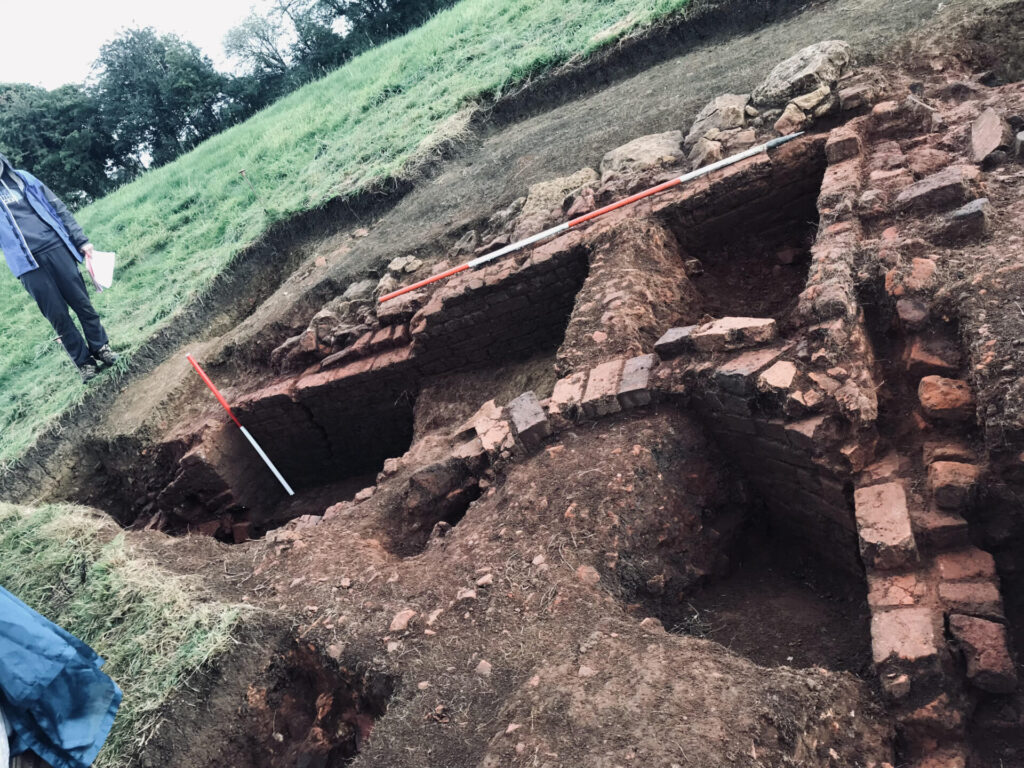
The group visited an archaeological excavation at Seend on a tempestuous afternoon, despite the thunder, lightning and rain we were able to get to the site itself. It is a 17th century kiln for the manufacture of bricks and smelting of iron. There was a major iron works close by although there is little evidence of it now. The canal had not been built so coal for the kiln was transported by other means from north Somerset. It is difficult to imagine the chocolate box village of Seend as a major industrial centre but it was. We were told about some of the jobs undertaken by the workers on site - it would not have met today's health and safety requirements!
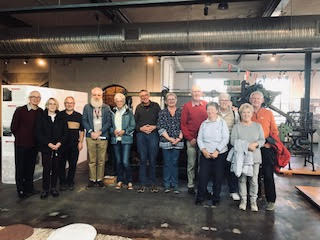
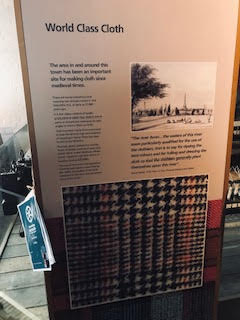
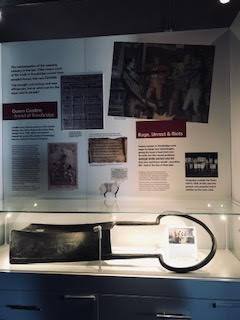
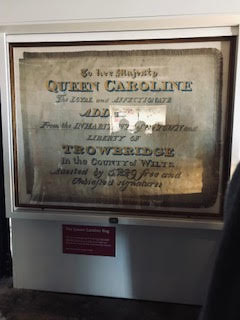
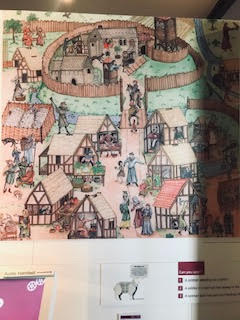
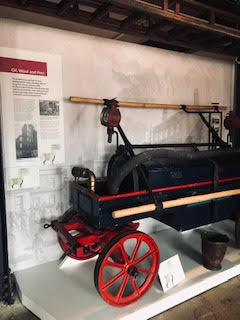
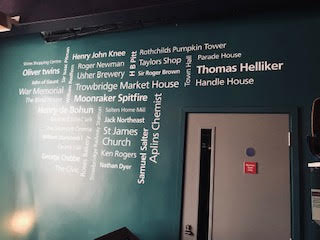
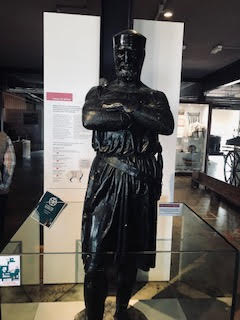
The group made its first visit to the Trowbridge Museum for about 10 years and its first since the Museum was revamped. We were all impressed with the displays some of which show the extent to which the woollen mill industry dominated the economic and social life of the town, especially in the late 18th, 19th and early 20th century. Some members of the group could recall the mills being operational as the last closed in 1960.
The nationally celebrated historian of the Tudor period, Dr Nicola Tallis, who had recently released her acclaimed biography of the young Elizabeth , gave a superb talk. It focussed on the relationship between the step- sisters Mary and Elizabeth. Both were the daughter of Henry the Eighth by different mothers, both were declared illegitimate by Henry in his desire to produce a male heir and both went on to become Queen of England.
The group's final meeting of the year was a talk by Ruby Vitorino on Highwaymen. In an interesting and entertaining talk Ruby explained that highwaymen had a public reputation rather like the Krays in the 20th century! Although some such as Dick Turpin were very violent the majority were popular figures despite being horse thieves, burglars and robbers. They acquired considerable wealth some of which they spent on their elegant clothing and appearance and some as bribes to jailers to enable them to escape from prison!
When they were close to capture they tended to relocate to a different part of the country but were usually eventually captured, tried and executed. Their execution was theatrical with the condemned man making speeches on the gallows before large crowds , many of whom were sympathetic to them!
Their hey day was the late 17th and 18th century. With the advent of the railways reducing the number of wealthy travellers by road and the enclosure of land making it more difficult to escape from the scene of the crime their were few who prospered into the 19th century
2025
January 2025: The group's first meeting of the year was an excellent talk by Jeremy Key-Pugh on the history of Bath Abbey. Jeremy explained that there had been an abbey in Bath since Saxon times but that the Abbey had fallen into disrepair, as did its Norman successor. The current Abbey was founded in the early Tudor period. From the 17th century onwards bodies were buried below the Abbey floor resulting in it sinking until the recent project restored it. During the course of the project the remains of those buried there were reinterred at Lyncombe Cemetry.
February 2025: The group had a talk from Terry Bracher of the Wiltshire and Swindon History Centre on ‘Crime and Punishment from the Medieval period to about 1800. Terry explained how crimes were ‘investigated’, the Courts system in which justice was dispensed and the range of punishments, often brutal, meted out.
Terry illustrated his talk with examples from Wiltshire. He ended his talk by showing a picture of the petition of 1842 from many Westbury citizens [held at the History Centre] seeking the abolition of the newly formed Wiltshire Police force as the citizens did not wish to pay for it!
March 2025: Nationally celebrated archaeologist and TV personality Julian Richards gave another of his excellent talks.
Julian explained how archaeologists use a wide range of techniques to discover and identify 'artefacts' including human remains. From these discoveries and identification archaeologists can reconstruct aspects of human life hundreds and thousands of years ago.
April 2025: Archaeologist Richard Osgood oversees Operation Nightingale which has been featured several times on TV. The project is designed to assist wounded military veterans through archaeology undertaken on MOD land. Richard first talked about the project a few years ago. On this occasion he updated the group on recent activities including one at Imber. He explained that the aim of the project is to enable participants to have the opportunity to acquire a range of skills and to rebuild their confidence.
May 2025: Dr Eleanor Barraclough gave a talk on aspects of the social life of the Vikings drawn from the runes which the Vikings carved on wood or ivory or bone. She showed that the Vikings spread from Scandinavia to Greenland and modern day Canada to the west and to Russia and parts of Asia to the east. She described the runes as similar to texting revealing issues such as romance, childhood and the more famous Viking violence.
June 2025: The group had a guided visit to Bath Abbey in June. The guide who was a source of information and entertainment guided us from the bowels of the Cathedral which were the subject of the Footprint Project over recent years up into the Abbey itself. He recounted its known history from being a priory established in the 7th century to the changes and new buildings made by the Normans and subsequently during the Middle Ages, to its abandonment at the Dissolution until its reestablishment at the end of the 16th century, by the celebrated Victorian architect Gilbert Scott and finally to the Footprint Project.
July 2025: On a scorching afternoon the group had a guided walk around the village of Norton St Philip. We met at the George Inn which dates back to about the 14th century and was the court house in which Judge Jefferies tried and condemned some of the rebels during Monmouth's rebellion of 1685. During our walk we were shown the sites at which the battle took place and the rebels condemned by Judge Jefferies were hanged, drawn and quartered.
We walked along the old road to Bath with its variety of buildings before ending the walk at the parish Church which dates from the Middle Ages and has been restored and revised over the centuries
September 2025: The 2025-26 season opened with a brilliant talk from Luke Winter entitled 'Experimental Archaeology'. Luke explained that he works mainly with volunteers in assessing and recreating buildings and structures from pre-history stretching back up to half a million years ago to the Viking age. He made the point that from these experiments using tools of the age there was probably no such thing as a 'standard' round house or building from a particular age but rather a range much like the variety of the modern age.
October 2025: John Tulloch gave a talk on one aspect of the war in the Far East, ie the Burma campaign undertaken by British and Commonwealth soldiers. John told is the harrowing account of a brutal war followed horrendous captivity for the POWs. Following the end of the war against the Japanese and the return home of the troops little was told of their experiences.
November 2025: Dr Cliff Williamson took us on a trip down memory lane talking about the social changes which have taken place in Britain, especially those in the 1960's and 1970's. Cliff spent time talking about the huge change in education with its potential job and career opportunities which occurred.
November 2025: The group had a talk from Professor Alice Hunt, a nationally celebrated historian and author on the 17th century . She spoke about decade immediately following the execution of King Charles the First. She made the point that there was no readily available alternative form of Government. As the decade advanced and with no clear consensus on the way forward Cromwell became Lord Protector, an outwardly similar form of Government to monarchy. However his power and role was very different from that of the executed King. Cromwell was subject to a written constitution [ the one and only in English history] which did not allow him any sense or pretence of divine right to rule.
December 2025: David Jenkins talked about the 3 World War Two POW camps in Westbury , two for Italians and one for Germans. David explained the process to which POWs were subject upon capture before being sent to a camp. He talked about the work which POWs were eligible to perform and the strict discipline which applied to them.
2026
January 2026: In January Dr James Taylor spoke about the voyages of HMS Beagle, commanded by Robert FitzRoy , on which Charles Darwin sailed and from which he did his observations of the different flora and fauna and which became the basis of his theory of evolution. James , who was Curator of Pictures at Greenwich Maritime Museum, explained that the crew included painters who were specifically appointed to paint and thereby record what was seen. James illustrated his talk with many of those paintings.
February 2026: In February official guide to the City of Bath , Steve Pratt, gave a talk on Medieval Bath which covered the period from the Norman Conquest to about 1700. Just prior to Bath becoming the fashionable 18th century town. Steve made the point that prior to the 18th century Bath had become a tourist area renowned [then] for its' waters. He explained that until its growth for about 600 years Bath had been small in area with a small and stable population, with the town having three main streets along which were the Abbey and Churches, housing, inns and industry. Steve said that it was remarkable that Bath Abbey continued to have Saxon leaders following the Norman Conquest, appeared to play no part in the 12th Century civil war, in the Peasants' Revolt and only a small role in the 17th century English Civil War.
March 2026: In March archaeologist Julian Richards explained in his usual excellent delivery how the ethnicity of Britain has evolved over the millennia. Julian showed that modern Britons have an ethnicity derived from ancient inhabitants and by conquest and immigration from Romans, Saxons, Normans, and in more recent centuries from refugees especially in more escaping from persecution in their native lands.
April 2026: In April Dr Alan Smith gave us the 'insider's' experience of the purpose and procedures of the House of Lords. Alan was for many years one of the Lords Spiritual [ ie one of the Bishops who sit in the Lords]. He talked about the evolution of the House of Lords from its previous pre-eminence from the Middle Ages to the 19th century when the democratically elected House of Commons being pre-eminent. Alan explained how the composition of the Lords has changed and continues to change. From his years serving there he clarified the various constitutional and political roles and responsibilities of the Lords [and how some of these are often misunderstood]
June 2026: 40 members went to Berkeley Castle which began to be built at the end of the 11th century. The castle has undergone changes but the original owners still own it and live in it. We were superbly guided and shown the cell in which King Edward the Second was , allegedly, gruesomely murdered in 1327. The house contains hundreds of valuable paintings and other artifacts. Close to the castle, and visited by many of the group, is the house in which Jenner developed the smallpox vaccine.
July 2026: On a tropical afternoon in July, 17 members of the group were guided around Salisbury. The guide took us to and explained the importance of sites including the Guildhall, the Market Place, St Thomas Church, Cathedral Close and the two oldest houses in the town, dating from the 14th century.
Links
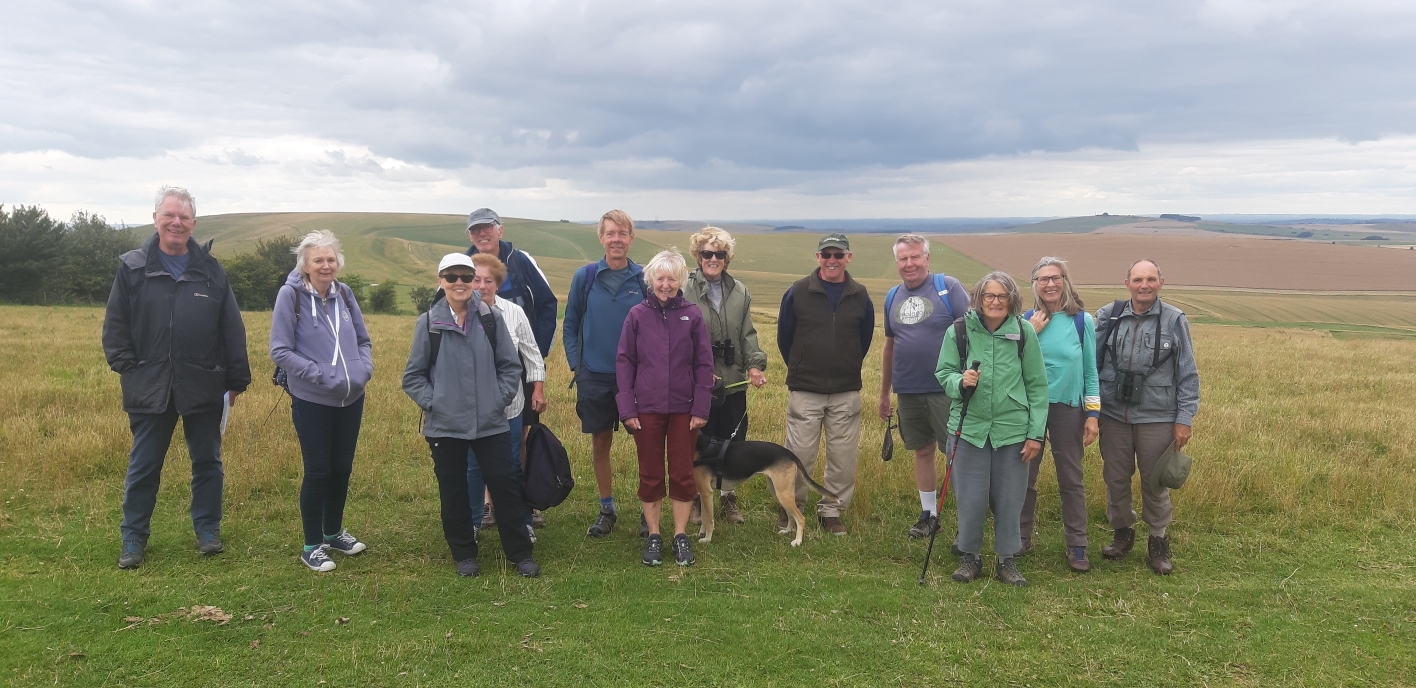
<<< More Group Pages >>>
Groups listed alphabetically
-
Art - Painting for Pleasure
Status: Closed
On Tuesday mornings 9:30 am-12:00 pm
1st and 3rd week, except in August -
Art Appreciation
Status: Active
On Wednesday afternoons 2:00 pm
3rd week -
Birding and Natural History
Status: Active
On Thursday mornings
3rd week -
Book Club
Status: Active
On Monday afternoons 2:15 pm-4:30 pm
2nd week -
Bookworms
Status: Active
On Monday afternoons 2:30 pm
4th week -
Canasta
Status: Active
On Monday afternoons 2:00 pm
1st & 3rd week -
Chair Pilates
Status: Active
Weekly on Thursday afternoons 3:15 pm-4:15 pm -
Chair Yoga
Status: Active
Weekly on Wednesday mornings 10:00 am-11:00 am -
Computer
Status: Active
On Thursday afternoons 2:00 pm
1st week -
Creative Textiles
Status: Active
On Wednesday mornings 10:00 am
2nd week -
Creative Yarn Group
Status: Active
On Wednesday mornings 10:00 am-12:00 pm
1st week -
French Conversation
Status: Active
On Wednesday mornings 10:30 am
3rd week -
Gardening
Status: Active
On Thursday afternoons 2:00 pm
4th week -
History & Archaeology
Status: Active
On Friday afternoons
Occasional day trips -
Mahjong
Status: Active
On Friday afternoons 2:00 pm
1st & 3rd week -
Music Lovers
Status: Closed
On Tuesday afternoons 2:00 pm
1st & 3rd week -
Photography
Status: Closed
On Tuesday afternoons 2:00 pm
4th week -
Pilates
Status: Active
Weekly on Thursday afternoons 2:00 pm-3:00 pm -
Something Snappy Photography
Status: Waiting list
On Monday mornings 10:00 am-12:00 pm
4th week -
Strollers
Status: Active
Weekly on Tuesday mornings 10:00 am-12:00 pm -
Table Tennis
Status: Active
Weekly on Wednesday afternoons 2:00 pm-3:30 pm -
Travel Buddies
Status: Active
Various dates
Page text last edited: 9/05/2026